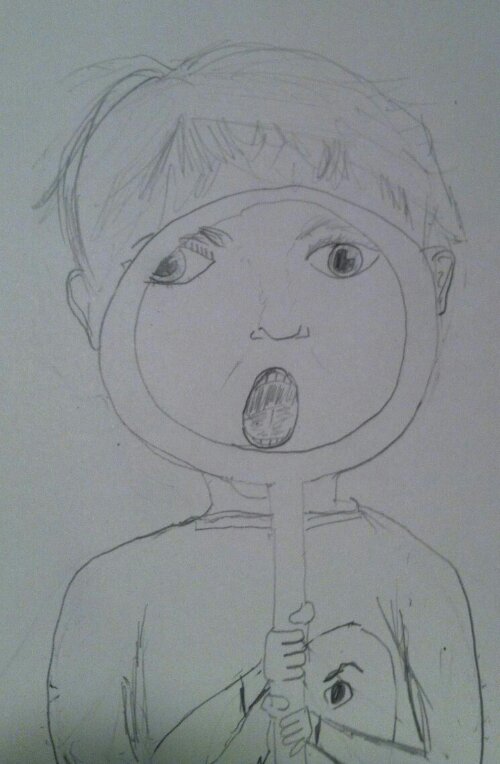
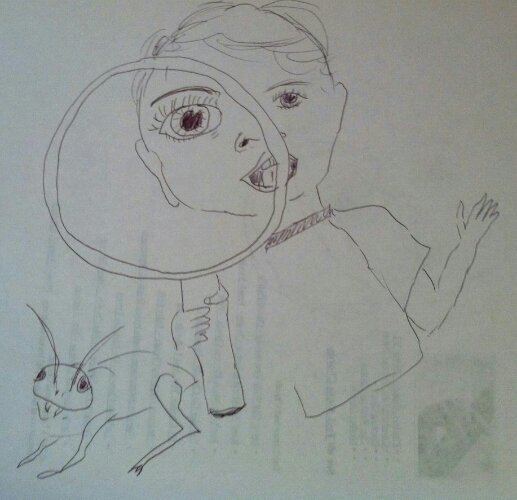
Category Archives: Joe the Bug Hunter

Joe the Bug Hunter: Shoo Fly

Charlie was chasing his tail. At least that is what Joe thought at first, but on closer inspection he realized he was after a bug. A fly to be exact.
image
The only thing Joe really knew about flies is that they have sticky feet and they liked stinky things.

He knew it would be difficult to catch, but he grabbed his bug gun anyway. It was worth a try.

After 40 minutes of chasing, Joe finally gave up and trudged over to the laptop to do some research.
image

He read about how flies lay eggs in batches of 75-150, but little white maggots hatch instead of baby flies. When they finally emerge into adult flies they fly around and eat rotten food to get the energy to lay more eggs. They are most active during the day. If they are inside at night, you’ll find them hanging out on the ceiling or in the corners not doing much of anything.

Joe was not impressed with the fly. What was it’s purpose? Laying eggs and eating?

The maggots, or fly larva, were kind of like mini worms. He read about fishermen who throw a handful of maggots into the water to attract the fish they really want.

“I wonder if Grandpa ever does that,” he murmured.

Suddenly, Joe had an idea. With renewed determination, he grabbed his bug gun and headed back to the kitchen.

“Mom,” he exclaimed, “I know what we can get Grandpa for Christmas!”

Joe the Bug Hunter: Silly Crickets

Chirp. Chirp. Chirp.

Every so often Joe heard it. A loud chirp, then a soft chirp. Fast, and then slow. He asked his mom what made the chirping noise.

“That is a cricket sound,” she answered. “Sounds like it is coming from the basement.”

“They can talk?” he asked, wide-eyed.

“No, they make the sound by rubbing their hind legs together…at least I think they do. Maybe you could do some research and tell me.”

That was all he needed. He grabbed the notebook he used to take bug notes and headed for the laptop.
image

He was surprised to learn that they were related to grasshoppers and katydids. He’d had a run in with both earlier in the year.

After reading about how they make the sound he turned to his mom and said, “Well, they don’t use their legs to make the noise. It says here that they use this big vein that goes along each wing. It looks like it has teeth on it. Cool!”

“And how do they make the noise?” asked his mom.

“They run the top of one wing along the bottom of the other. Kind of like a zipper. They hold their wings open to make a loud, echoey chirp.”

“Cool,” said his mom.

“Yep. Don’t worry Mom, the leg thing is a popular myth. I’m sure lots of people thought that.”

Joe’s mom just smiled.

As Joe read on he learned that there were four types of cricket songs: the calling song, the courting song, the aggressive song and the mating song.

The calling song was for the girl crickets, but it was loud to let the other boys know to stay away.

The courting song was really more like the dating song and it’s very quiet.

The aggressive song comes out when another boy cricket is near and the mating song was for after a good cricket date.

Other crickets could hear the chirps because they had a little membrane below their tiny cricket knee.

He was a little grossed out to read that they eat their own dead if there is no food around. Other than that they eat dying plants, fungi and seedling plants. They don’t usually bite people, but when they do it hurts because they have super powerful jaws.

Chirp.

“I’m going to go investigate. These things lay eggs about now and it says they can hatch up to 200 per female. We don’t want these in the house…they eat seedling plants.”

“Yes, please do! We’ll be starting our plants in the basement for next year’s garden and we don’t want them eating our seedlings.”

Joe quietly tip toed around the basement living room with his bug gun at the ready, stopping every so often to wait for the chirping to start up again. Finally he found the little guy. It was in the bed of one of his dump trucks.

image

Joe chuckled, “Well that was easy.”

He looked at it for a few moments and remembered something he had read. His eyes lit up.

“Mom!” he shouted. “We need a big lizard!”
image

Joe the Bug Hunter: Spiders, Spiders Everywhere

Joe hummed “The Itsy Bitsy Spider” as he watched the small black spider spin its web. He’d been watching it for 10 minutes and marveled at its grace.
image

But, what kind of spider is it? A question he couldn’t ignore.

Sighing, Joe watched as the little bug climbed down the wall, seemingly finished with its web and perhaps going to hunt. He had the bug gun waiting and the bug house standing by for observation. Gently he squeezed the trigger, sucking the scared little thing into the containment jar and slowly dumped it into the waiting bug house.

And now for the research.

Spiders are amazing creatures. Joe read wide-eyed the many talents of the house spider. The males wander around hunting small bugs. They rely on their vision and speed to catch food and carry it back to the web. They are sensitive to light and, depending on the threat level, will either move toward or retreat quickly from it.

“Cool,” Joe whispered when he read that they have 8 eyes, six of which look forward for prey…the other two darting side to side to keep a lookout for threats or more tiny bugs to eat.

They don’t just wander, unless they are not bothered by any threat. They move with purpose and stop to think and evaluate where to head next. They can run long distances if they need to. Joe imagined a tiny spider marathon.

Joe looked back at the web and noticed that it was funnel shaped, a common way to catch its prey. It was also very intricate with silk threads spun over the flat window sill. Joe’s eyes widened when he read that the webs could get very big if they were left undisturbed.

The girls can live a long time…one to two years if no one squishes them, so they try to find spots that are hidden like the basement or the attic. Joe wondered why this one picked the window sill in the living room.

Eggs are laid in late fall. There could be up to 50 eggs. Whoa! Joe smiled thinking how much his mom would like 50 little spiders racing around the house. NOT.

They hatch in the Spring and molt over 7 times to become adult spiders.

Joe read how they retreat when attacked or disturbed rather than fight back. It is easy to catch them as they will walk straight into a cup or container. If they do bite, it doesn’t hurt. Joe wasn’t willing to test that theory though.

Joe thought it was cool that they caught bugs. If he told his mom that, would she leave it alone? Probably not.

He thought and thought, looking outside at the swingset and shed.

The shed! He could relocate it to the shed. If he just let it go outside the poor thing would die when it got cold, but maybe in the shed it would have a better chance of survival. He checked the web to see if eggs had been laid yet and seeing no egg sac he took the bug house and headed outside.

wpid-IMG_0628.jpg

Once he got into the shed he looked around trying to think where to let it go. He finally decided it had the best chance up in the rafters.

Slowly he turned the bug house on its side and opened the lid. The spider stayed very still for a few moments and then tentatively darted forward, stopped, and then quickly ran out of the bug house. It settled itself in the corner and after a few minutes started to reconstruct its web.

Joe decided that if his mom ever noticed the spider in the shed, he would let her know that they eat garden pests like aphids. She would like that.

Joe the Bug Hunter: The Leaf Artist (illus. by Linda Kane)

Joe and his mom were out collecting leaves in the yard. They were going to use them to make leaf rubbings for fall decorations. After he was sure he had chosen leaves that would make the most beautiful rubbings, Joe gathered them all up and followed his mom inside.

As they were sorting their loot in the kitchen, Joe noticed one little leaf was crawling across the table, trying to escape. Taking a closer look, he discovered legs and tiny antennae.
image
Quietly, Joe went to get his bug house and field guide to observe and find out just what kind of creature would dress up as a leaf.

Turning the first few pages in the bug guide, Joe saw it. The Katydid.
image

Diet: Foliage and flowers, stems, petals, fruits, etc.
Habitat: Trees, shrubs…basically anywhere with lots of plants.
Predators: Spiders, ants, frogs, birds*
Lifecycle: Eggs are laid in the fall and nymphs hatch in the spring.
Fun Fact: Katydids are mostly nocturnal as it is easier to hide at night. They are shy, antisocial pests that make music by rubbing their wings together.

*Baby katydids, or nymphs, are the perfect high protein food source for baby birds.

Joe sat back in his chair and looked at the Katydid sitting in the bug house. The field guide had been generous when it called the noise of the Katydid “music”. It was more like the sound of a record being scratched over and over again to the cha-cha rhythm.

wpid-IMG_20131029_143319.jpg

He stared thoughtfully at the bug. He couldn’t ignore what else the field guide had said…Katydids made a feast of any green, lush foliage they encountered. And their eggs were the perfect first meal for baby birds!

Wait.

Of course! If Katydids had come to the homestead, there was a good chance of attracting beneficial birds to the garden: Chickadees to eat the Katydids, Nighthawks to eat the squash bugs and Blue Birds to help the chickens with the grasshoppers!

Picking up the bug house, Joe headed to the bathroom. As he shut the door, he made a mental note to fill the bird feeders with sunflower seeds and suet.

Flush.

Joe the Bug Hunter: Grasshoppers in the Mulch

It was a crisp October day and Joe was outside walking the property. With his bug gun in his holster he wandered by a pile of wood chips the family had planned to use for mulching the garden beds. He stopped suddenly when he saw a few chips puff up in the air.

Slowly he approached the pile of mulch. With his super sensitive hearing, honed to sense bug sounds, Joe could hear the “Puff, puff, puff!” of the chips as they flew in the air. Joe crouched down and waited to see what was causing this movement.

After a few moments, three or four tiny grasshoppers jumped in unison, almost gracefully, above the pile. Joe smiled and reached for his weapon but stopped short, remembering he would need to observe and research the habits of these creatures first to discover why they had come to invade his mulch.

Slowly, Joe put the “observation” attachment onto his bug gun and captured one of the grasshoppers. He carried it back to the porch and dumped it into the bug house, a perfect place to observe…close up…the activities of the grasshopper. Now for the research.
image
Joe knew that grasshoppers liked to eat cereals, leaves and…well…grasses. He also knew that they did virtually no preparation for winter hibernation. So he was a bit surprised to see them in the wood chips in October. Why weren’t they in the huge grassy field gorging themselves as they are known to do?

After researching for a bit, he learned a few surprising things about the pest. Apparently, their little bodies are high in nitrogen, so in their death they not only help the decomposition of plants, they also help with soil amendment. They do a better job of this then large piles of poo because they have little bodies that are more easily broken down in the soil.

But…the benefit of these little guys does not outweigh the risk of millions attacking and ruining a robust and thriving garden so the grasshopper must go. After combing all his usual sources Joe was certain of what steps needed to be taken.

He smiled, knowing that he would be getting a few new pets on the homestead.

“Mom! We need chickens!”

Joe the Bug Hunter: The Case of the Horned Worm

Something was eating the tomatoes.

Joe sat on the deck staring at the plants and wondering. The plants were too close to the house for it to be deer so it must be a rabbit on stilts doing all this damage. He knew what had to be done so he went inside to get his tools.

Armed with the bug gun and bug house, he quietly walked through the tomato plants observing the bug life.

Ladybugs. Those were good to have around. They eat those pesky aphids.

Butterflies and bumblebees. Known pollinators…essential bugs for the garden.

Worms. Wait, huge worms. Green, striped, GIGANTIC worms!

Joe slowly raised his bug gun and opened the house, ready for this unknown bug. He pulled the trigger and with a “thwap” the worm was contained safely in the house. He put some leaves from the tomato plants in with it so he could observe and discover its weaknesses.

image

Joe sat and watched. At first, the worm just lay there. Probably too scared to move in the presence of such a skilled bug hunter, thought Joe. Then, slowly, it started chomping. Before Joe knew it, an entire stem was stripped of it’s leaves and the horned worm was wrapped around a cherry tomato chomping away.

After finishing the tomato off, the worm lay back seeming to drift off to sleep. Satisfied that he had enough information, Joe went inside and started to research this type of wormy behaviour.

At first, all signs pointed to the “tomato horn worm”. Big, green, striped and eats tomatoes. But on closer examination, the stripes were not quite right. The tomato horn worm had 8 v-shaped stripes while the worm Joe had captured had 7 diagonal gray and white stripes.

Tomato Horn Worm

Then he found it. The tobacco horn worm had invaded the garden.

File:Tobacco hornworm 1.jpg

Joe looked at the mega-worm in the bug house, wondering how to combat this beast. What would scare it and it’s buddies away from the garden? The time had come to observe some more.

Joe went back out to the garden, carting his safari chair, a bottle of water and a snack. It would be a long afternoon. He set up camp behind a screen of tomato plants and waited with his binoculars at the ready.

Before long, the horned worms started slithering up and down the tomato plants, chewing and chomping away. It took all of Joe’s self control not to pull his bug gun out right then.

More time passed. Joe was just about to pack up for the day when he saw it. One of the worms had what appeared to be tiny white rice all over it’s body. He whipped out his magnifying glass to take a closer look.

The tiny white rice were actually tiny white cocoons. Not wanting to kill what could be a potential friend to the garden, Joe went back inside to do a bit more research…and it’s a good thing he did.

The cocoons belonged to a wasp that lays eggs just under the skin of hornworms, providing ready food for the baby wasps when they are born. The growing wasps pretty much suck the life out of the hornworm so that when they finally emerge, ready to start out on their own, the hornworm has no energy to continue it’s assault on the tomato plants.

Joe leaned back in his chair with a satisfied smile on his face. The troops were already deployed…all he had to do was make sure that there was plenty of cilantro and dill planted to attract them to their prey.

Time for a tall glass of milk and a sleeve of Oreos.


Adventures in Homesteading: The Cactus Bug, Introducing Joe the Bug Hunter

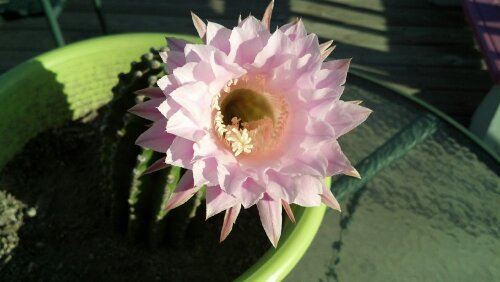
Lissa’s cactus had finally bloomed. One gorgeous pink flower that lasted a little over a day. Joe stood on the deck admiring it.

image

By the next day, the flower had shriveled and fallen off onto the deck. Joe frowned, staring at the spot on the cactus where the flower used to be. He squinted his eyes and looked closer…something was moving on the cactus. He looked closer still and saw a tiny black and gray spider crawling around a cactus spine.

He knew what he had to do. He went into his room and, making sure no one was watching, opened the secret compartment in his toy box. He pulled out his safari hat, bug house and bug gun. These are the tools he would need to investigate what had happened to the flower…for Joe just knew that the spider had something to do with it’s untimely demise.

Joe the Bug Hunter was on the case!