Category Archives: 13 Skills

13 in 14: New Year, New Skills

Last January, we came up with a list of 13 skills we wanted to master, or at least obtain in 2013. We decided to continue pursuing new skills this year…and to finish the ones we just didn’t get to last year.

1. Sewing – My first attempt at sewing was rather lame. Ok, it was a complete failure and it has since fallen apart. So I’m going to give it another go this year with the goal of making Halloween costumes for the boys.

2. Auto Upkeep – I’d like to learn how to change the oil in my van.

3. Firearm Training – Now that I’ve learned the ins and outs of shooting a rifle, I’d like to continue my training and learn to handle and shoot a handgun via a conceal carry class.

4. Wilderness Skills – Ray and I are excited to start camping with the boys. It will probably be back yard camping to start, but it will be a wonderful opportunity to teach (and learn) basic wilderness skills.

5. Teaching – Since we are teaching the boys at home, I am going to continue to work on curriculum planning. I’m also going to set up an activities area in the basement complete with a work table and bookshelves – a one stop shop for all of our supplies.

6. Reloading – Here’s one we didn’t get to last year. We are going to get that reloading press set up and Ray is going to teach me how to reload.

7. Health and Fitness – I think this will be a continuing battle against laziness and lack of motivation. Learning better and healthier cooking options will be the top of the list.

8. Raising Chickens – I’m so excited about this one! You know how sometimes you have to stop talking about it and just do it already? I’m reading up on raising chickens right now and making sure all of the zoning requirements are in place. Fresh eggs are in our future!

9. Bee Keeping – We definitely don’t want to bite off more than we can chew this year, so my plan is to read up on bee keeping so that we can add that to our homestead in 2015.

10. Gardening – This past year I completed my PDC. This year, and for many more years to come, I will be working on maintaining that PDC and implementing the practices and techniques I learned in the course. We are planning to install our very first swale this year, and to design our gardens using polyculture techniques.

11. Archery – I’ve always thought archery was beautiful. Ray has a bow and a target so I am going to ask him to teach me the basics.

12. Blogging – Now that I’ve been blogging for a year, I’d like to learn some tricks on increasing traffic and promoting content.

13. Canning – Pretty much a bust last year, so we are going to try for it again with our garden crop this year. If we don’t have a great year for tomatoes and beans, we’ll supplement with produce from the Farmer’s Market or friends and neighbors who have more than they can use.

And there you have it! Our list of new skills to–ahem, master in 2014. Stay tuned for more detail on each as well as progress reports.

Sewing a Seat Sack: A So-So Result

My first sewing project. It was supposed to be a seat sack for quickly storing magazines, coloring books and other odds and ends when clearing the dining room table for dinner. I saw the idea on Pinterest and thought, “Oh, that looks like an easy first sewing project for me!”

image

And it would have been…had I bothered to check my enthusiasm and actually read through the directions a few times before starting. Perhaps a seasoned veteran in sewing could have whipped this together without a problem, but I am not seasoned in the art of sewing so I should have known better than to try and “wing it” on my first go.

The first part was easy enough. Ok, it was easy enough after my grandma showed me how to sew a seam correctly. Apparently, when you are sewing a seam, the pretty sides of the fabric you are working with should face each other. I had just folded the fabric in half and started sewing which resulted in a frayed and sad looking seam.

There are several videos on YouTube that are helpful to watch before you start sewing your seam. This is the one that I found to be helpful.
http://www.youtube.com/watch?v=5zrL68Nq1z4

image image

After watching the video a few times and reading the section on seams in Sewing for Dummies, I was ready to try again. When I finished my seam was very uneven and not quite as beautiful as I had hoped, but after flipping the fabric around I let out a little giggle because at least it slightly resembled a seam!

image

image

Then I went back and sewed the top. In hindsight, I should have done this step before sewing the seam. Not only would it have made it look prettier than it does, but it would have made the whole thing a lot sturdier. (Alright, so I only realized this after going back and fully reading the instructions.)

I’m not really sure how much weight this pocket will be able to hold so I may end up using it to store plastic grocery sacks instead of heavy books and magazines. But, I am considering this a success in that I learned how to (correctly) sew a seam, which I’m told is the most basic of sewing techniques. Boy do I have a long way to go!

Mead: Nectar to…Everyone

Fall. Apples. Honey. Cider. Mead.

I like dry red wine. I have to be in the mood for sweet and bubbly. Yet…there is something about a good mead that I am always in the mood for. The sweetness isn’t light or crisp…it’s warm and hearty like a cider with the punch of a glass of merlot.

My grandma called me and told me the branches on her apple trees were dragging the ground with the weight of their fruit. So…the boys and I went apple picking at Grandma’s house. Another item checked off our fall bucket list.

Grandma had already made 18 quarts of applesauce that she is distributing to the grand kids, so we decided to make mead.

The Materials
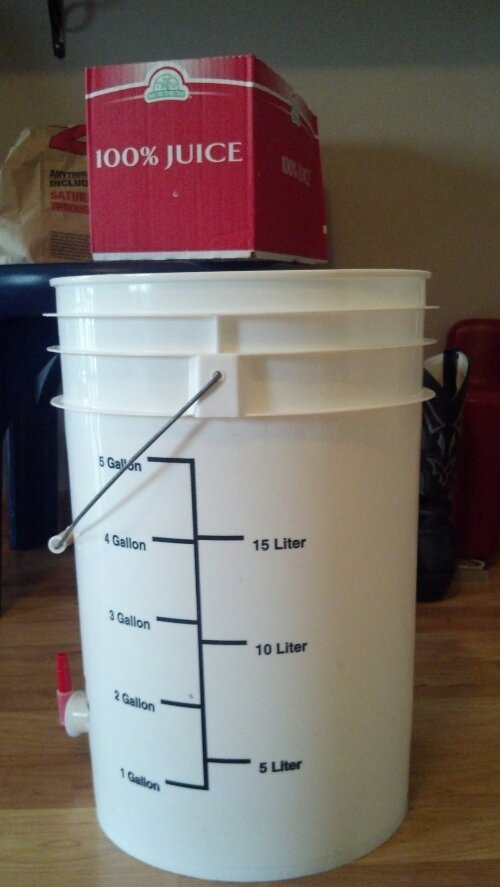
5 gallon bucket (food grade with lid)
1 airlock (can also use a balloon and rubber bands, but it is worth it to purchase an airlock)
Siphon
5 gallon glass jug (also called a carboy)
Sanitizing solution
Hydrometer for measuring ABV (alchohol by volume)
1 bung (rubber stopper)
Glass bottles

wpid-IMG_20131016_091023_544.jpg wpid-IMG_20131016_091230_711.jpg

The Ingredients*
3 gallons apple juice (It doesn’t have to be fresh)
1 gallon water
2lb brown sugar
10lb pure honey
5g wine yeast

*Note: These are the ingredients and amounts we used. You can adjust the recipe to your taste, use different fruit, skip the brown sugar and adjust the amounts. Technically, when made with fruit, the drink is called a cyser. You can make it with just honey and it will turn out just fine. 

The Method
Sanitize everything each time you are going to use it. Instructions will be on your sanitizing solution.

Pour apple juice in a 5 gallon bucket. If you juiced fresh apples there will be a thick foam on top that you will need to skim off. I am going to use it in cookies or some sort of baked good.
wpid-IMG_20131015_122800_062.jpg

Add ingredients in this order, stirring after each addition: brown sugar, honey, water and yeast.

Stir well, put the lid on the bucket and the airlock on the lid and place bucket in a spot where it won’t get messed with.

This is the first step in making mead. Right now, our mead is fermenting in the bucket and the water in the airlock is bubbling away. You will know when your mead is ready to go to the next step when the water in the airlock stops bubbling.

When that happens, wait three more weeks before transferring to the glass jug. This is where the siphon comes into play.

Siphon all the liquid, leaving the sediment behind. It should settle to the bottom of the bucket. Place the bung on the bottle and test every couple of weeks until it reaches the abv you are shooting for. Your yeast packet will have a tolerance listed…we use that as a guide but not a hard and fast rule.

When the abv is where you want it you will need to wait a minimum of 6-8 months before bottling. This is to make sure that the mead has degassed which means that there is no more CO2 in the mead. This is important so that you don’t have glass bottles exploding all over the place.

Once it tastes good to you, it’s ready to be bottled and stored in a cool dark place. While the mead is now drinkable and probably tastes pretty good, resist the urge to drink all of it right away. Remember, the longer it sits, the better it tastes.

Patience, young brewer, patience.

Saving Tomato Seeds: An Alternate Method

Awhile back I wrote a post about saving tomato seeds. I tried the method but when I dried the seeds on a paper towel they got stuck and I couldn’t pull them off without pulling the paper towel too.

I’m hoping that this alternate method does work and will report back on my progress.

Materials Needed: Clear container, kitchen strainer and a coffee filter or a paper plate.

Steps:
1. Cut larger tomatoes in half lengthwise. Cherry or grape tomatoes are too small for that so cut an X in the bottom or top.

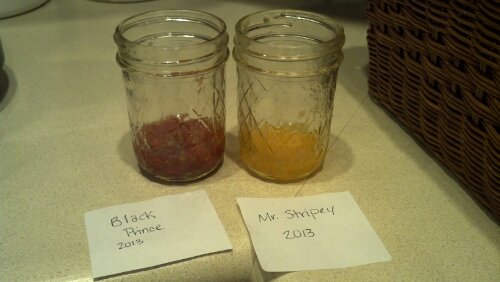
2. Squeeze seeds and pulp into the clear container. I used mason jars.

3. Place the container in a spot where they won’t get jostled (or messed with by curious toddlers). There will be mold and it might get stinky, so put them in a spot where you won’t mind the stench. The mold is part of the fermentation process that needs to happen in order for the seeds to be viable, so don’t freak out.
image
image
4. Once the seed coats float to the top, the seeds are ready for the next step.

5. Add water and stir. The mature seeds will sink to the bottom and immature seeds will float to the top; you’ll only want to save the mature seeds.

6. Pour out the immature seeds and pulp being careful not to lose the seeds at the bottom.

7. Put the mature seeds in a strainer and wash thoroughly.

8. Spread them out on a coffee filter or paper plate. Remember, spreading them on a paper towel results in a complete fail.

9. Then, put the seeds somewhere to dry out of direct sunlight for 4-6 weeks. When they are completely dry, they will crack easily. Either bite into them or bend them.

10. Store them in an airtight container, labeling unless you want to be surprised when they come up the next year.

I’m at step 3 and I’m waiting for the mold.

My Permaculture Design

Although I have not yet received feedback on my design, I thought I would share it to give a better understanding of what Permaculture is and how it can be applied. This is based on my understanding of Permaculture after having gone through the course. Once I receive feedback, I will share it.

DesignProject_Permaculture


Update! PDC Certificate Received

I am officially a certified Permaculture consultant. 🙂

image

Permaculture Design Course (PDC) – Complete!

A few months ago, I shared my jitters and doubts about signing up for an online PDC taught by Geoff Lawton in the post Permaculture Design Course: A Rambling Confession. In this post, I rambled on about my nerves, my worries that I couldn’t (or wouldn’t) keep up with the coursework…that I would give up.

Well I didn’t give up. Sure, I had a few moments of despair and cried to Ray that I should never have signed up for the course, that I couldn’t understand certain principles and concepts, that I never would “get it”. But, he calmly reassured me and told me that learning this stuff takes time and that no one would get it on the first go around. I would have to study continuously and put the concepts into practice to truly understand. In my frantic state, I had forgotten that the best way to truly learn is by doing.

So, below is a drawing of my design.

IMG_20130923_214222_915

I won’t pretend I know or completely understand everything about Permaculture. This drawing is not as “fancy” as some of them I have seen and my report is far from professional. But, I will say I that my knowledge and understanding of Permaculture has grown by taking this course, and I will be able to confidently implement what I have learned on our property…and I’m excited to get started.

Stay tuned for a follow up post after I have received feedback on my design and I will share my final report as well!

Canning Tomato Sauce from Frozen Romas

The time is here. I am ready to can my first only batch of tomato sauce for the season.

Now I am more of a get-it-all-done-at-once type of person so we froze the tomatoes we didn’t eat or share..whole…until we had enough to can. I couldn’t believe how easy it was to get the skins off by just running the tomatoes under hot water!

We had about 15-20lbs. This is a guesstimate based on me standing on a scale without the tomatoes and then standing on it again with the tomatoes to see the difference.

IMG_20131102_123508_763 

Now for the recipe. You can scale it up or down depending on how many pounds of tomatoes you have. I didn’t really follow the recipe. I added herbs and spices to my taste. The basil, rosemary, parsley and thyme were all from our garden!

3 lbs tomatoes
2 whole bulbs of garlic, cloves separated
1/2 cup olive oil
salt and pepper, to taste
2 tbsp dried basil
1 tsp dried oregano
1 tsp dried thyme
1 tsp dried Rosemary
Lemon juice, about 2TB
Parsley
Red Pepper flakes
Red wine

Preheat oven to 350 degrees.

Coat a baking dish with olive oil and throw in tomatoes, garlic cloves, salt and pepper.

Now…I love garlic so I added 12 whole bulbs. Yep, 12.

IMG_20131102_134356_246

Bake for around an hour.

IMG_20131102_141815_888 IMG_20131102_134350_063

Remove and let cool slightly. Fire up the food processor…a blender would work too…and place tomatoes in food processor bowl and blend, blend, blend. Once it is at the consistency you want, transfer to a pot.

Add your aromatics: basil, oregano, thyme, parsley and rosemary and any additional salt and pepper to taste. Then add the rest of your seasonings. Bring to a boil then reduce to a simmer.

IMG_20131102_163845_303

I let it simmer for about 4-5 hours…until I thought it tasted right. Then I let it cool to room temp and strained it to get all the stringy bits and seeds out. I used cheese cloth, but I think a colander would work too.

And now for the canning.

Yeah, that didn’t happen.

By the time it had cooked down and been strained, we had about 4 quarts left. I froze 2 quarts and made some chili with the rest.

image

image

The sauce tastes spectacular and has just a small bit of kick from the red pepper flakes. Sure I’m disappointed that we didn’t actually can any…but I’m very excited to have such an awesome recipe for next year.

And from the smell coming from the stove, the chili is going to be delicious.

The Truth About Thistles: A Permaculture Revelation

Since May, I have been watching videos for my online permaculture design course (PDC). It’s a slow process with the busy-ness of summer, but I am about halfway through and the design deadline has been pushed back to the end of September. Whew!

There are two dvds dedicated to soil. TWO! When I saw that I thought I would surely fall asleep during those videos, but the “life” of soil is strangely fascinating. Especially fascinating to me was the video I watched last night on pH. Geoff Lawton, the professor of the course, was making a “supermarket” analogy to explain soil pH.

He drew a birds-eye view of a supermarket. Each aisle was a mineral or nutrient: Zinc, phosphate, potassium, nitrogen, copper and iron. The shoppers were all of the plants that need different nutrients. As all of the plants crowded in to shop for what they needed, the aisles got blocked so that all of the plants were not able to get in and get what they needed.

Enter the thistle.

Now, we have an abundance of thistles. I’m constantly pulling, cutting and cursing them. So naturally, my ears perked up even more.

The thistle loves acidic soil, or soil rich in copper and iron. Wait. What? We have very alkaline soil, how is it we have so many thistles? Wait for it.

The thistle has a deep tap root so it can dig down much farther than the other plants, weeds, etc. So when the store aisles are blocked and the plants that need iron and copper can’t get it, the thistle knows another way in the store.

It’s not necessarily that the soil is deficient in iron and copper, maybe they are just being blocked out. The thistle, knowing all the secret pathways, can dig down past the block and find the iron and copper and bring it on up to the top of the soil

Does this mean we should just let thistles run rampant on our property? No, that would lead to too much of a good thing. The key, I’m learning, is balance. Soil is a living being that needs tended to just as much as the plants in your garden.

The answer? Chop and drop and compost…removing seed heads of course.

There are other problems with our soil and other areas where it needs to be repaired and amended, but I am a little relieved to find a relatively easy answer to our acidity problem.

13 in 13 Progress

This is exciting. It is only mid-August and I’ve started or “completed” almost all of my 13! Usually, I am super motivated until about January 31 and then I figure I gave it a go so I can slack off for the rest of the year. Not this year!

Here we go!

Gardening. I am still going strong and very happy with the lessons I’ve learned along the way. I didn’t plant everything I said I would plant, but I made the decision to cut my losses so we could have a more successful first year.

Sewing. Well, I sewed a rather crooked line on my practice fabric and then had some problems with the sewing machine. Luckily, my grandma was able to fix it but now I have lost all motivation to start again. In October, I am going to make the boys’ costumes. They will be Thing One and Thing Two. I know, I know. It sounds like a cop out to simply sew white circles on a red sweatshirt. Well that’s too bad. I’m counting it!

Finance. I wanted to become a bit more savvy…ok, I wanted to be able to understand discussions about interest rates, 401ks, the stock market…not doing so great on this one but I still have a bit more time.

Canning. Luckily, canning season is only just now approaching and we have already canned some okra and cucumbers. Next up: tomatoes.

First Aid. I’m going to take a beginner CPR class next month with some other mom’s from the MOPS group I joined.

Water Catchment. So I did not technically acquire this skill, but I feel like it is at least in progress because Ray installed a rain barrel a few weeks ago.

Vinting. COMPLETE! On to the second batch to become even more skilled.

Marksmanship. COMPLETE! At least my first go at it is complete. Are you ever really done with marksmanship training? Or, any of these skills for that matter.

Writing. I’ve hit my goal and feel I am improving constantly.

Gardening. Ditto for the above.

Permaculture Design. Almost done with this one. I’m so grateful that the design project due date has been extended to the end of September. Not that I could not have got it done by the end of August of course. The extra time just gives me a chance to perfect my design.

Fitness. I feel more fit due in large part to gardening and chasing the boys around. I also surpassed my goal for 5ks. Initially I said three, but I have now done 4 with a plan to do one or two more this year. However, I have not kept up my running in between 5ks. So I don’t feel that this goal is truly complete.

Cooking and eating healthy. I actually feel like we are doing great with this…most of the time. Our weeknight meals are really healthy and chock full of veggies and protein. We could improve our weekend meals. I’m not sure why, but I have always thought that the food you eat on the weekend or on vacation does not count. I’m not delusional. I just really like ice cream.

So that’s everything! I’m very proud of the progress I’ve made and, if I do say it myself, impressed that I have not given up on any of them. Of course, it really helps to have a great husband and family to constantly encourage me to keep going.